5 Key Differences Between a Backpack and a Rucksack
By admin | May 13, 2026 | Bags and wallets
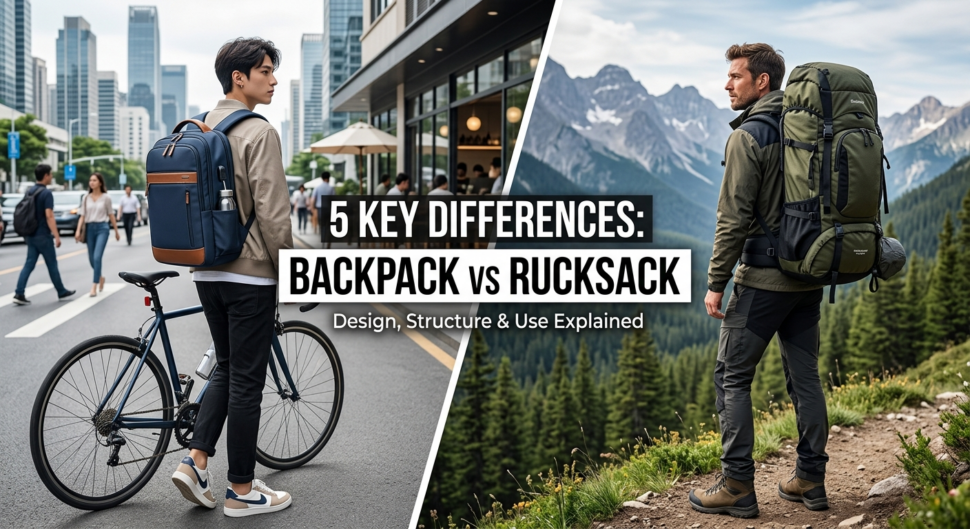
Ask 10 people what a backpack is, and you’ll likely get 10 different answers, many of which will be unclear. What is the difference between a rucksack and a backpack? What is a rucksack? Isn’t a rucksack just a bigger backpack? Aren’t they the same thing? I wonder what rucksacks are for? I think they are for hiking?
All partially right. None completely right
The truth of the matter is that these words are used interchangeably, particularly in casual speech. However, there are genuine, practical differences between the two types of bags in their design, construction and use. If you are purchasing one for the first time, those distinctions have a lot of importance.
This question is always at the forefront of our minds at Rays Creations. So, we’ve compiled this straightforward and non-fanciful explanation of the 5 major backpack vs rucksack differences, leaving you to walk away with your choice.
Let’s clear this up once and for all.
What Do These Words Mean? (First Things First)
Let’s be on the same page before we get into the differences, so here are some definitions.
What Is a Backpack?
Any bag with two shoulder straps that is used on the back is considered a backpack. It is used all over North America and much of the world, going from a child’s school bag to a high-tech laptop commuter pack.
Today, the term backpack is most often used to describe a more refined backpack that is lighter and more streamlined for travel in everyday situations or for urban environments. School, work, travelling, gym. These are travel territories where backpackers can go.
What Is a Rucksack?
Rucksack comes from the German Rücken (back) and Sack (bag), literally, a bag for your back. In British English, it’s just another word for backpack. You’ll hear it as much as you hear “backpack” used in the United States in the countries in which it is spoken.
The term “rucksack” has become synonymous with a larger, structured, load-bearing pack designed for outdoor pursuits, such as hiking, trekking, camping and extended outdoor use, but in the real world of outdoor gear and adventure travel, “rucksack” has come to mean something different.
Here’s one thing to remember: rucksacks are spelt a variety of ways. Rucksack, rucksack, or even rugzak (English for the Dutch word) may be seen. They all refer to the same item. The correct English spelling is rucksack for one word without a space.
With that as a foundation, let’s get into the five differences that matter.
Difference #1: Size and load capacity
The first and most obvious difference between backpacks and rucksacks is the one that becomes apparent first to most people, namely, backpacks have a front. This is the easiest to see difference between backpacks and rucksacks, and often the first thing that will help someone determine what they need. Backpacks have a front.
Backpacks: Designed for daily loads.
Most backpacks can accommodate a laptop, a notebook, a water bottle, a gym kit, a phone charger, and perhaps a packed lunch. This amounts to a capacity of about 15 to 30 litres.
The average school backpack size is 20-25 litres. A commuter or laptop backpack is typically between 18 and 25 litres. The capacity of most everyday backpacks is under 30 litres, as it becomes cumbersome to carry without proper load support if they are any bigger.
Rucksacks: Designed for serious volume.
Rucksacks are on a whole other level of size. Rucksacks used for day hiking usually begin at 25-35 litres. Multi-day trekking rucksacks are from 40 to 65 litres. The giant backpacks that serious mountaineers and long-distance hikers use for their expeditions can hold up to and more than 70 litres.
This is an additional volume for a reason. For a multi-day trip, a tent, sleeping bag, cooking equipment, layers of clothes, food, a first aid kit, and water should be brought along. No matter how creatively you pack that into a 25-litre backpack, it isn’t possible.
The lesson to be learned: If you are planning to take any equipment with you for more than a day, you require a rucksack. For a day or less, a backpack is invariably enough.
Difference #2: Frame and Load Distribution System
This is the one that most people don’t know about, but is definitely the most significant difference from a comfort and health point of view.
Backpacks: Minimal Internal Structure
Most day-to-day backpacks will feature a thin foam or plastic frame sheet sufficient to shape the backpack and provide minimal back protection, in addition to a padded back panel. For lighter loads (7 – 8 kg or less) carried for a few hours at a time, this is ideal.
But they do not have a design that accommodates the weight evenly. A serious backpack carries a lot of weight, and everything hangs off your shoulders. This places a lot of strain on the shoulders and neck over time (even during a long day).
Rucksacks: Heavy Duty Backpacks.
A hiking rucksack is an entirely different engineering proposition. Most of them have either of the following frame designs:
Internal frame: Aluminium stays or a moulded frame that is located inside the pack. These flex in accordance with the movement of the body, and so the rucksack’s movement feels more natural on trails and uneven terrain.
External frame: The stiff external frame that the bag attaches to (historically, of aluminium or steel). These are less common these days, but they do exist for use when the expedition load being carried is very heavy and the necessary weight capacity outweighs flexibility.
This is very important because both systems are used in combination with a padded hip belt. The correct fit for the rucksack will shift the load from your shoulders to your hips by about 70–80%. Your hips are much more powerful than your shoulders and better able to carry weight. This is why experienced hikers are able to hike with their backpacks loaded with 20 kg for 10 hours without being too tired to move a single foot.
The take-home lesson: When you’re carrying more than 8-10 kg or for more than a few hours, a framed rucksack with a hip belt is not a luxury; it’s a physical necessity.
Difference #3: Access Points and Organisation Style
You’ll find that there is a lot of difference between a regular backpack and a rucksack in terms of how you get in, and how your items are organised once you’re in.
Backpacks: Organised for Urban Life
Contemporary backpacks are targeted at organisations. This is because a good laptop bag has a specific compartment with padding for the laptop, a tablet pocket, a front organiser panel with pen loops and card pockets, side water bottle pockets, an anti-theft back pocket that is hidden from view and a key clip.
All things fit. Such a compartmentalisation is ideal for anyone who works in an office, studies, or commutes and wants to grab the charging cable, notebook or transit pass in no time, without having to rummage for them.
Most backpacks feature a full-length zip at the main compartment access, which unzips to open the backpack as wide as a suitcase, accessing as much of the backpack as possible from the front. Packing and unpacking are quick and easy.
Rucksacks: Designed for Volume Access
Traditional rucksacks are those that have a top-loading mechanism, meaning that you open the top of the rucksack to access the main compartment, which features a removable or adjustable lid pocket. Highly weather-proof with no large exposed zips, and can be put together in a logical way: heaviest items next to your back, lightest at the top, this design is commonly used outdoors.
The downside is that to get to the bottom of a tightly packed rucksack, one must unzip from the top. That’s why, for those who have been on a trek before, experienced trekkers are very careful about what they put at the top of their bags and what they put at the bottom.
Many modern hiking rucksacks have an additional zippered compartment in the bottom for sleeping bags and an additional zippered pocket on the front for ease of access to mid-trip use. The overall philosophy is still towards volume rather than compartmentalisation.
The real-world application: Do you find yourself needing access to several items throughout the day that need to be organised quickly? Backpack. Must transport considerable amounts of equipment securely in the weather? Rucksack.
Difference #4: Materials and Weather Resistance
The material your bag is constructed from makes a difference in its longevity and durability.
Backpacks: Wide Range of Materials
Backpacks are made from a wide range of materials, from lightweight nylon and polyester to canvas, leather and even recycled fabrics. Canvas rucksack (yes, I know, canvas bags are often referred to as rucksacks, even though they are just everyday bags, but can still be very vintage and durable if used for light loads).
Nylon or polyester is standard for commuter and travel backpacks that are required to be water-resistant. Most urban backpacks will accommodate a light shower but are not designed to be exposed for any length of time. For heavy use in high-weather areas, some high-end backpacks have completely waterproof zippers and taped seams.
Rucksacks: Built for the Elements
The materials for hiking rucksacs are generally high-denier ripstop nylon or Cordura, which is a thick, durable fabric that is resistant to abrasion. These materials are selected because they are resistant to tearing, rocks and branches, and long exposure to wet conditions.
Most rucksacks designed for the outdoors also have (or can be fitted with) a built-in rain cover, which covers the entire pack when it rains. This isn’t something that the average backpack has.
When you need to use the sleeping bag for multiple days in unpredictable conditions, this isn’t a luxury; it’s a necessity, as when a storm comes out of nowhere at 2,000 metres.
The lesson learned: When it comes to city use and light weather, backpack materials are sufficient. A hiking or camping backpack made of actual weather rucksack-grade materials is essential to hiking, camping or any use outdoors that requires the use of the backpack outside of the classroom.
Difference #5: Purpose and Intended Use
All the above is reduced to the simple use for which each type of bag is intended.
Backpacks: Your Daily Companion
Backpacks are suitable for everyday living in a human setting. School. The office. The gym. The airport. Weekend city trips. They’re designed to be comfortable to wear while carrying a reasonable amount of weight, in style for social situations and make your daily routine a little easier.
As for backpacks themselves, the smart backpack with integrated USB charging ports, RFID-blocking pockets, anti-theft locking zips and tech organisation is their evolution as of 2026. This is no ordinary bag. It’s a productivity tool.
These backpacks are solving everyday human problems, whether they be big school backpacks, large backpacks for women, commuter packs, camera bags, diaper bags, etc.
Rucksacks: Your Adventure Partner.
A rucksack for life off the pavement. It is the bag that you have to grab when civilisation is a few days’ walk away. If you’re on mountain trails, in camp in the backcountry or in your pack for a month-long journey.
Generally, a beginner’s rucksack will hold about 30-40 litres, which is suitable for a full day hike with food, water, safety and a layer change. For more arduous hiking, such as overnight or multi-day trips, the practical capacity is 50-65 litres.
The action step: Purchase a backpack for everyday use! Purchase a backpack for hiking. If your life is your adventure, then they don’t really overlap very well at all.
Quick Reference: Backpack vs Rucksack at a Glance
| Feature | Backpack | Rucksack |
| Typical Capacity | 15–30 litres | 30–100+ litres |
| Frame System | Minimal / none | Internal or external frame |
| Hip Belt | Rarely | Standard feature |
| Load Capacity | Up to ~8–10 kg | 10–25 kg+ |
| Access Style | Panel/clamshell | Top-loading (usually) |
| Organisation | High — multiple compartments | Lower — volume-focused |
| Material | Nylon, canvas, polyester | Heavy-duty nylon, Cordura |
| Rain Cover | Rarely included | Often included |
| Best For | Daily use, commuting, travel | Hiking, camping, trekking |
| Style | Urban, clean, varied | Functional, utilitarian |
Selecting the right one for you, a guide for beginners.
When you’re new to buying bags and getting dizzy from too many choices, the easiest rule is:
You need a backpack if:
- When you are on your way to school, work or the gym
- You bring a laptop and essentials for the day.
- You use a plane, train or city transit to get to work.
- The way you are dressed and the way you look are important to your setting.
A rucksack is required when:
- You are going hiking, trekking or camping
- You will be carrying 10kg or more.
- Your trip is overnight or longer
- You will be exposed to the real weather conditions
You might need both if:
- You have an active lifestyle, from commuting in the city to outdoor adventures.
- You are a frequent traveller and also enjoy walking at your destination
Frequently Asked Questions (FAQs)
Q1. What is the difference between a backpack and a rucksack?
A1. The distinctions between a backpack and a rucksack are in size, structure and use. They are usually smaller (15-30L), light in weight and used for everyday wear. Rucksacks are bigger (30 to 100L+), have internal frames and hip belts for load distribution and are designed for hiking, camping and prolonged outdoor use.
Q2. What is the definition of the word rucksack?
A2. Rucksack is a combination of the German words Rücken (back) and Sack (bag), meaning “back bag. In British English, it’s used interchangeably with backpack. Outdoor use: a large, organised bag used for hiking and long-term carrying. It can also be written as ruck sack, or rucksack, and all of these spellings mean the same thing.
Q3. What are the different types of backpacks in simple words?
A3. Backpacks are available in a variety of styles, each designed for specific purposes: daypacks (lightweight 15-25L for daily use), laptop backpacks (tech-organised for commuters), travel backpacks (35-45L carry-on size backpacks), hiking daypacks (25-35L basic outdoor backpacks), trekking rucksacks (40-65L frame and hip belt backpacks) and expedition rucksacks (65L+ for multi-day backpacking).
Q4. What is the purpose of a hip belt on a rucksack?
A4. A hip belt on a rucksack distributes most of the weight of the pack from the shoulders to the hips. Your hips are stronger and more able to accept the load, and this will significantly lessen shoulder and back fatigue in long carries. The right fit hip belt will take 70-80% of the pack weight off the shoulders.
Q5. Which is more efficient for a backpack: top loading or front loading?
A5. It depends upon the usage. A top-loading rucksack is more weather-tight and will suit people more when used on trails where you pack once and carry all day. Backpacks with a front-loading mechanism (clamshell or panel) allow you to reach everything from the front, making it convenient for travel or everyday use when you need to reach into your bag often.
Q6. What is the best backpack for a novice?
A6. The basic requirements for a hiking rucksack for beginners are that it is 30-40 litres, has padded shoulder straps, a simple hip belt, a hydration sleeve or external water bottle pockets, water-resistant and an empty weight of less than 1.5kg. When you are just beginning, fit and comfort should be a more important consideration than brand.
Q7. Can I use a backpack for hiking?
A7. A sturdy backpack will suffice if you are going on a light day hike and have little gear. For any kind of load exceeding a few hours (more than 8 kg) or over a few hours, a suitable hiking rucksack with frame and hipbelt is highly recommended. A heavy, poorly padded backpack can cause serious shoulder strain and back pain when hiking.
The Bottom Line
The backpack vs rucksack debate is not only about the backpack name, but it’s also about design philosophy, purpose and how it will affect your body at the end of the day.
Backpacks are a daily companion. Adventure Tools: rucksacks. They are both very good at their jobs. The error is to place the one in the other’s space.
Know your purpose. Choose accordingly. Invest in quality. And have fun in the process wherever it leads,
Find Your Perfect Bag at Rays Creations.
We sell durable, high-quality backpacks, ranging from sleek, everyday models to rugged outdoor models.
You can use a backpack as a student, commuter, weekend hiker, or hardcore trekker. We have the bag for your life.
Buy the complete range of backpacks and rucksacks today and travel the globe with confidence!
No Comments yet!